|
Background
What happens when agrichemical companies are sued en masse by people who have been harmed by exposure to the manufacturers’ toxic pesticides? Answer: Bayer-Monsanto, Big Ag and Chemical lobbyists buddy up with politicians to try every possible avenue to obtain immunity from accountability. They push for bills that give the corporate poison pushers immunity at the state level, at the federal level, and even from the Supreme Court.
Bayer-Monsanto, headquartered in Germany, has been hardest hit by pesticide litigation. Roundup weedkiller lawsuits are a huge financial drain. Over 170,000 lawsuits have been filed by people who developed cancer, primarily non-Hodgkin’s lymphoma, from exposure to glyphosate-based Roundup. The litigation has cost the company billions of dollars and its shares have plummeted. Bayer’s market capitalization is now at less than half of what it paid to acquire Monsanto in 2018. And its legal woes are not over by a long shot.
Bayer isn’t alone. China-owned ChemChina-Syngenta also faces nearly 6,000 lawsuits alleging that its paraquat-based herbicide, Gramoxone, caused plaintiffs’ Parkinson’s disease.
Bayer’s strategy has been to pass laws, state by state, that take away the ability of farmers, landscapers, and other individuals to sue if they get sick. If passed, the bills would protect Bayer (and all pesticide corporations) against claims it “failed to warn” people about the potential health harms of Roundup, or any other pesticide produced, as long as the product is labeled in accordance with Environmental Protection Agency’s (EPA) weak regulations. This means that Bayer’s cancer victims would no longer be given their day in court and no future lawsuits would be allowed in any state that has passed these bills.
The revolving door between industry and regulatory agencies swings wide and often, and corruption at the EPA is well documented. Pesticide regulations and product label requirements are not protective of human or environmental health, only providing illusions of protection while allowing chemical makers to keep selling dangerous toxins.
Bayer’s lobbying efforts have resulted in the introduction of immunity bills in 11 states during 2025 legislative sessions—Florida, Georgia, Iowa, Idaho, Mississippi, Missouri, Montana, North Dakota, Oklahoma, Tennessee and Wyoming. The bills were written by industry attorneys and sponsored by Republican politicians.
These Monsanto Protection Acts have passed in North Dakota and Georgia, signed into law by Governors Kelly Armstrong and Brian Kemp, respectively. Our supporters and other activists were able to stop the bills in all other states.
The state-level bills are not moving fast enough to save this evil empire.
In desperation, Bayer is pulling out all the stops to save itself.
- Bayer has petitioned the EPA to modify pesticide labeling regulations that would effectively give it, and the entire pesticide industry, nation-wide immunity.
- Bayer submitted a petition to the Supreme Court of the United States (SCOTUS) arguing that the court should hear its case to resolve a split among lower courts on whether federal labeling laws preempt state labeling laws, betting that the Republican supermajority of justices will side with it. On December 1, 2025, Trump’s DOJ Solicitor General Dean John Sauer recommended that SCOTUS hear Bayer’s appeal and filed a brief supporting Bayer. If SCOTUS rules in Bayer’s favor, it could bring all Roundup-cancer and Paraquat-Parkinson’s disease lawsuits to a close.
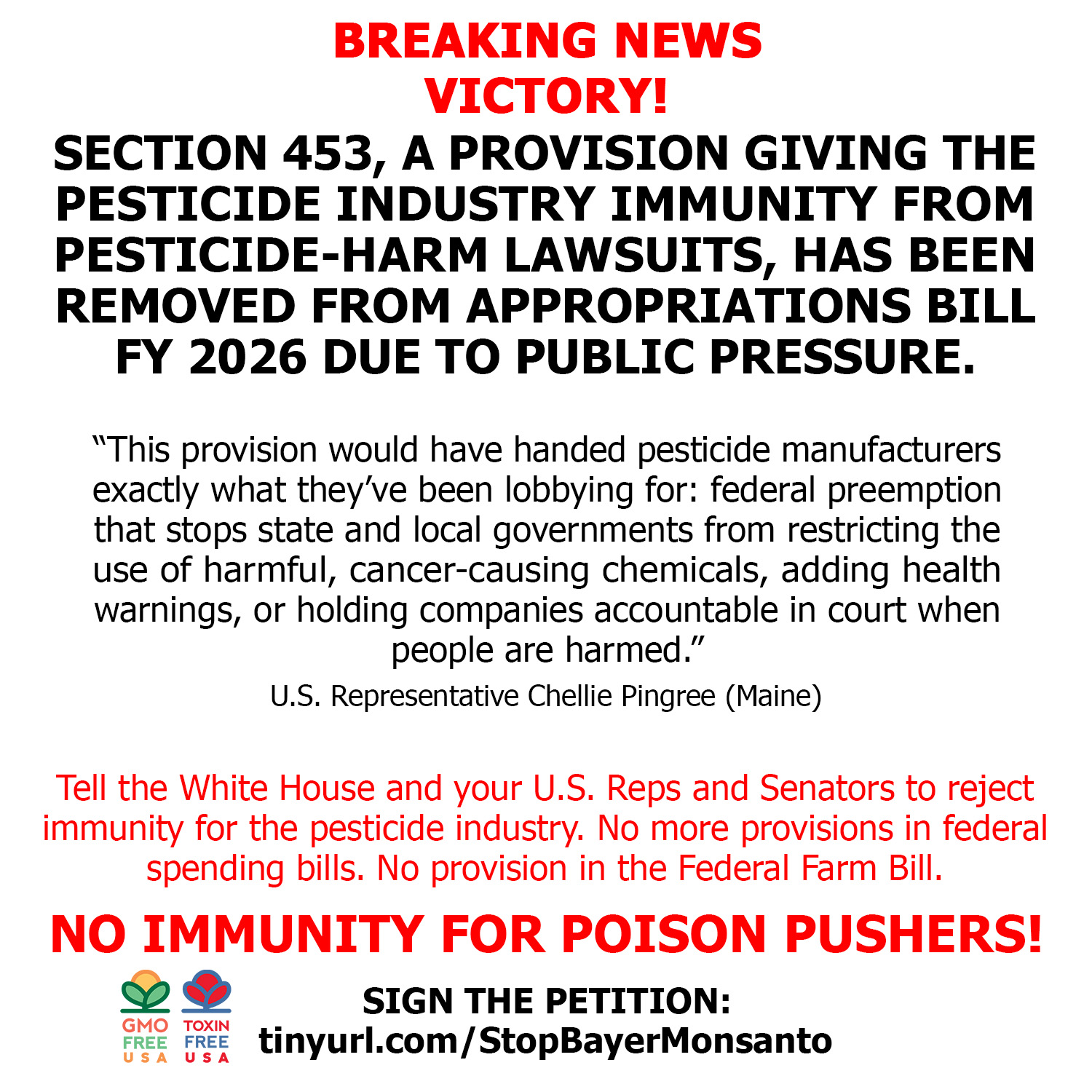
- Meanwhile, Bayer and Big Ag lobbying groups like CropLife America and the American Farm Bureau Federation are using their political influence in Washington D.C. to ramp up campaigns for a legal shield. House Republicans added Section 453, a provision giving the pesticide industry immunity from pesticide-harm lawsuits, to the Appropriations Bill Fiscal Year 2026 (federal spending bill). And Republicans plan on adding an amendment into the next Federal Farm Bill that would provide the pesticide industry with permission to poison without accountability.
House Agriculture Committee Chair Representative Glenn Thompson (R‑PA), having taken hundreds of thousands of dollars from the industry, is pushing his fellow lawmakers to do Bayer’s bidding.
We’ve seen it all before. In the spring of 2013, Monsanto’s minions worked hard to pass the first Monsanto Protection Act, which would have allowed Monsanto and others to sell genetically modified seeds even when courts blocked them from doing so.
The bill became law. But a groundswell of people across the U.S., including many of you, contacted their Congresspeople demanding the law be rescinded. By the fall of 2013, we succeeded in stopping that Monsanto Protection Act.
People Power can and does work. |